The work is a sculptural video in which a familial heirloom jacket from 19th-century Naxos encounters an oversized ceramic ear, referencing an archaeological artifact exhibited at the island’s Archaeological Museum. Through the video work, the sculpture transforms into a topology of shared experiences and interactions, and into a field of coexistence that redefines the relationship between material, place, and subjects—where the collective and the social become intertwined. The piece evokes the timeless depths of the sea, where memory is suspended and histories drift beyond linear time. Like oral traditions carried across generations, voices and stories are woven into the surface of the work, echoing through both material and form. In this way, the sculpture becomes a vessel of listening—an interface where submerged narratives and embodied knowledge resurface and resonate in the present.
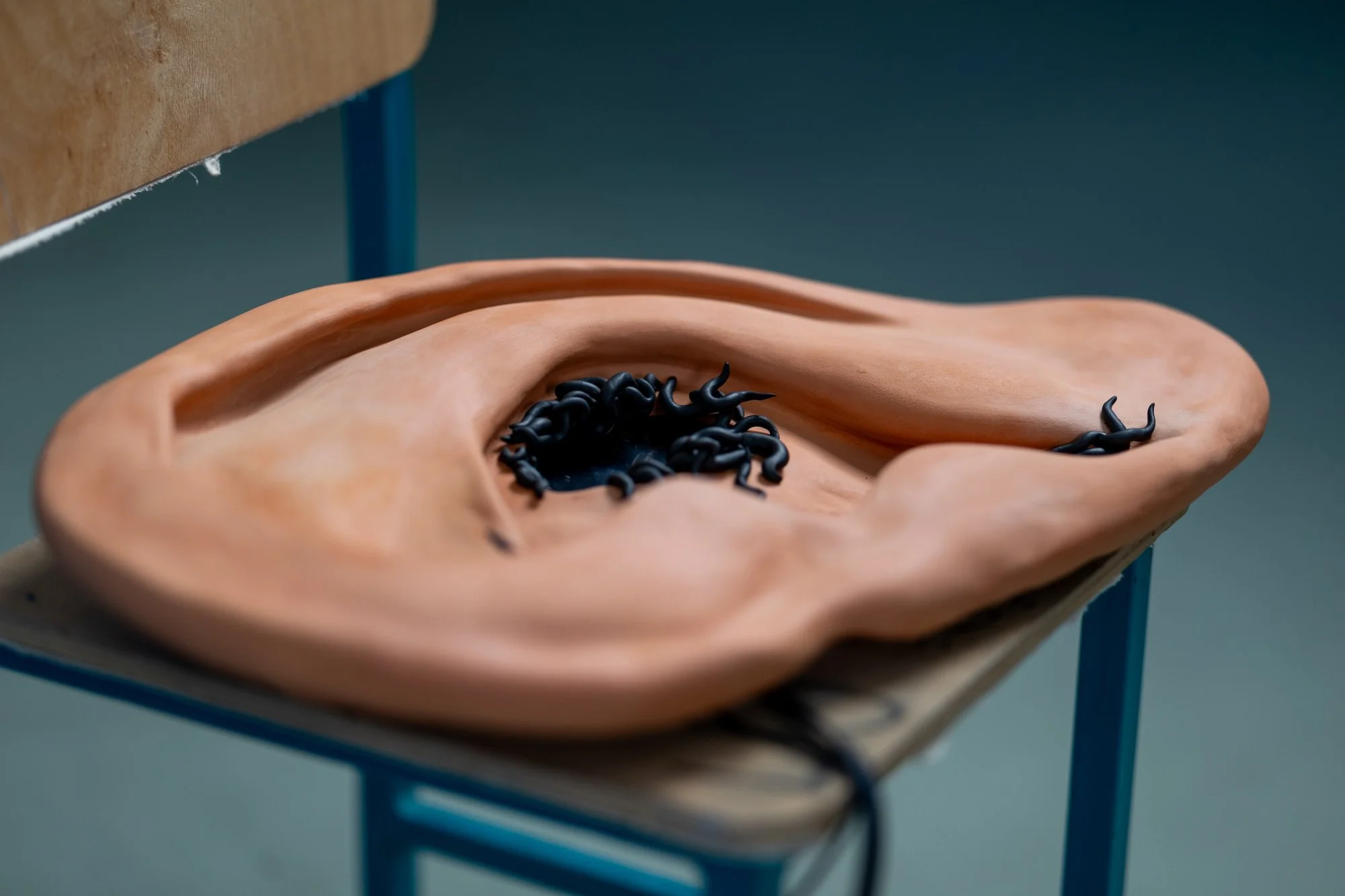
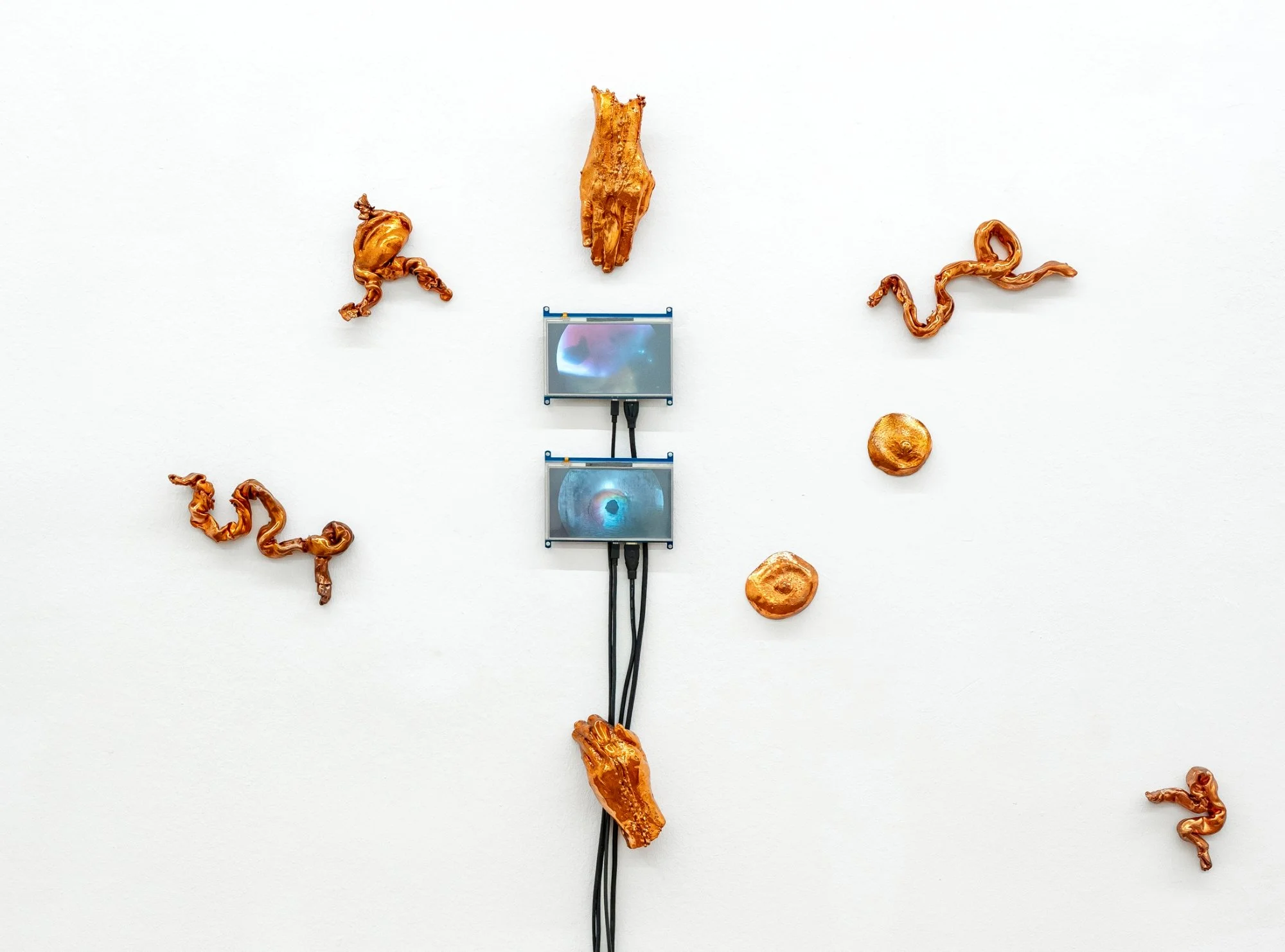
The work “Description without Place” tries to unravel a world where monstrosity and dreams intertwine, blurring the lines between the real and the imagined. Through ambiguous forms and shifting perspectives, it challenges rigid social structures, questioning the limits imposed on the human body. This hybrid body emerges as a site of tension and possibility, entangled in an ecosystem where human and non-human universes merge, dissolve, and reconfigure in endless transformation.
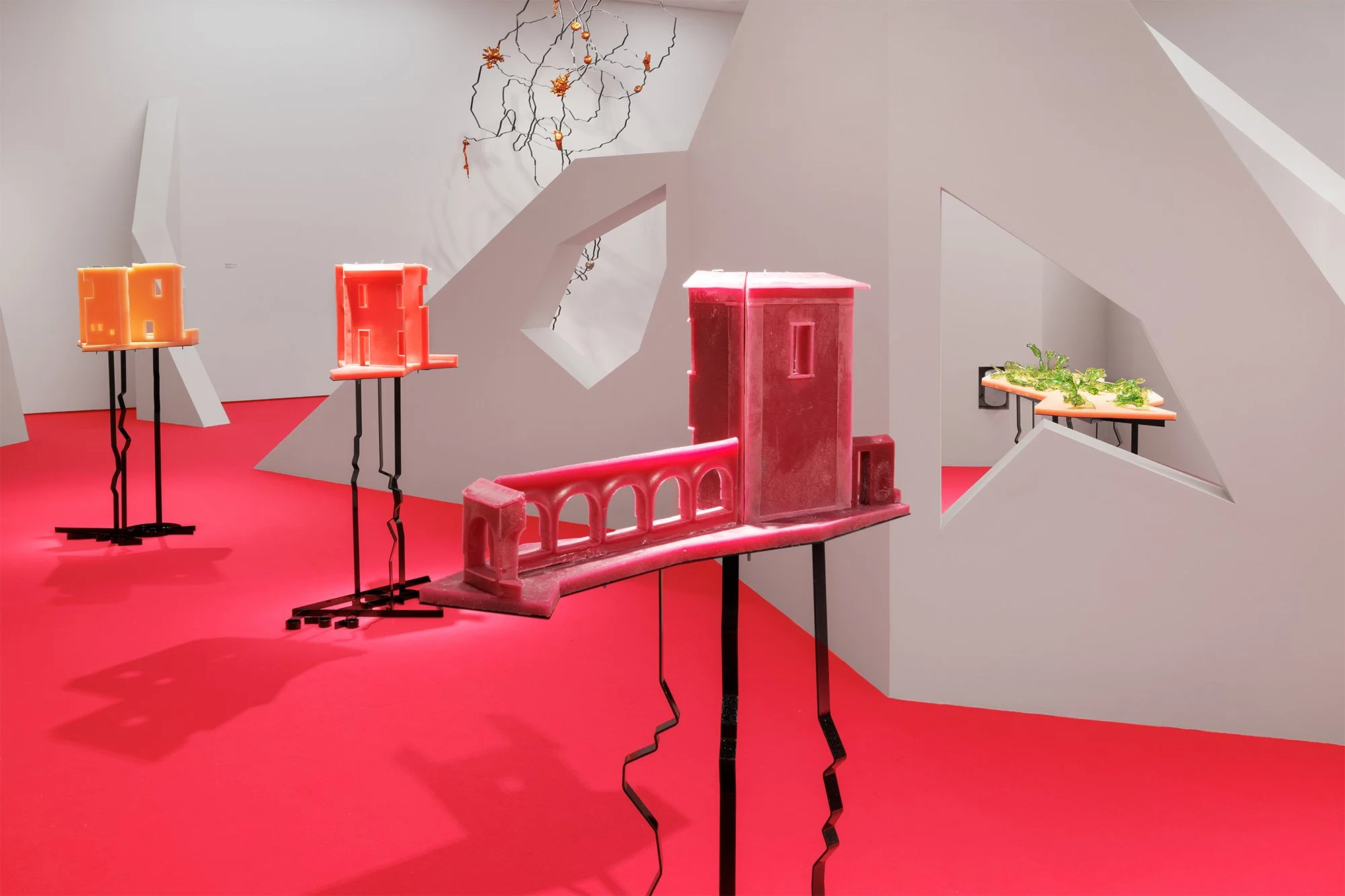
The exhibition at EMST, “All Dreams Are Vexing”, is the outcome of the research in the summer of 2023 on the island of Spetses, at the house where the first Greek female painter, Eleni Boukoura-Altamoura (1821–1900) stayed isolated following the tragic premature deaths of her two children from tuberculosis. During that period, the painter became involved in spiritualism in an effort to reconnect with the spirits of her children, leaving behind her a handful of legends and a grimoire — a magical manuscript containing spells.
Upon entering the exhibition, the visitor crosses the threshold into the house’s corridors as well as into Eleni Boukoura-Altamoura’s mind. The exhibition space has been transformed into a total installation, a locus of “magic” where sculptures made of glass, wax, and bronze converse with sound and video works. As the wax sculptures burn and transform, the blown glass parts — breaths, ghosts, and the energy of an unseen world — symbolise the ineffable and the silenced, while the bronze elements of her sculptural compositions, that is, the human organs, the intestines, the plant stalks, and the flowers become a grounding force that keeps us anchored and present in the here and now.
Re-approaching the myth of “the madwoman in the attic” the exhibition seeks to frame the practice of magic through a new feminist perspective, where occultism and loss intersect with the hidden history of women's roles in the domestic economy and art.The exhibition unfolds around two research axes, firstly, the re-negotiation of Boukoura-Altamoura’s house as a symbol of geniality and isolation, as a second layer of skin that protects and suffocates her at the same time. Secondly, on the examination of symbols from Boukoura-Altamoura’s magical manuscript — one of the few existing ones in Greek letters – and their recontextualisation as carriers of memory.
Curated by Anna Mykoniati
The exhibition is a new production by EMST as part of the exhibition series “What if Women Ruled the World? Part 2”
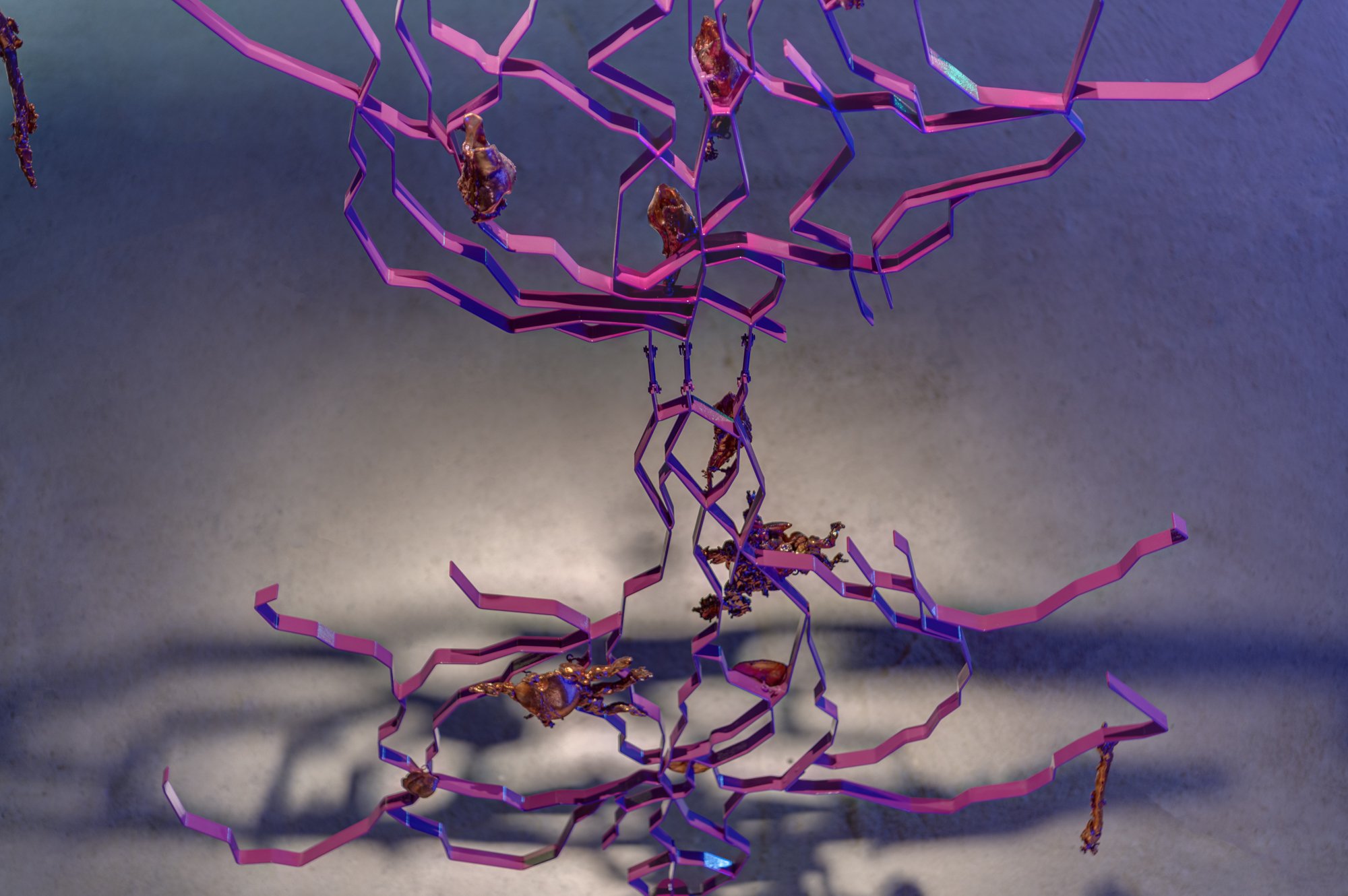
The sculptural installation “Why, without pity on these studious ghosts, do you come dripping in your hair from sleep?” is a six meter long song about rethinking our relationship to nature that you cannot hear but you can see and read. The work is based on a research about a Greek folk song called ‘The voice from the grave’ that was found in different variations in many places in Greece and on the intersection of drawing and sound which Iannis Xenakis was analyzing in his writings. The waveforms of its lyrics were transcripted into a new “graphic score” and is activated by the copper sculptures of the hybrid human and animal parts and by the breath that is captured in the blown glass piece. The “new” song that the viewer only reads traces its various narratives through the shadows of collective memory and functions as a mechanism of reapproaching the connection of ecology and magic.
Commissioned for the group show “Outraged by pleasure” curated by Nadja Argyropoulou, Nobel Building, Athens, 2023

What if refrains are seen as mechanisms for reconnecting humans with nature?
The installation draws on the study of practices of fortune-telling, magic, and refrains in the local traditions of Ioannina and the wider region of Epirus. An allegorical sculptural system of hybrid creatures carry fragments of refrains, but also elements of human and animal parts. Every one of them has been created as part of a graphic score from a refrains’ transcription broken down into waveforms. Formed as part of the bioscape, they function like time machines.
Commissioned by Onassis Stegi for the “Plásmata II: Ioannina” exhibition

In the exhibition “The mornings grow silent”, the presented installation is inspired by the industrial past of Syros. A plate from the former glass factory Ermis (1870–1898) in which a spider is depicted on its web is at the core of the research and the spider is approached both as a symbol and as a carrier of different systems of perception and re-creation of the world. An oversized web containing anthropomorphic prey and a series of amorphous glass elements that spin hypnotically transform the empty atrium of the Hermoupolis Town Hall into a reservoir of narratives: about the island's industrial era, its laborious and anonymous production, the constantly woven architectural web of the city compared to the intuitive web of the spider, as well as the body’s idiosyncratic placement, human and non-human, in its surroundings.
During the exhibition, a small part of the installation is displayed in the Industrial Museum of Syros along with the glass objects of the Ermis glass factory. Such a gesture extends the installation beyond the Town Hall, inviting viewers to make their own path through the city, leading very close to the site of the now demolished former glass factory.
Curated by Eva Vaslamatzi

The installation “A cage in Search of a Bird” consists of the works “Alpha continues to begin. Omega is refreshed at every end (Noomena series I–IV)” and “So that morning and evening are like promises kept”. They are based on the theory of Iannis Xenakis’s “arborescences” and the bird taxidermist Dimitris Katsoris and was presented at the Anargyrios & Korgialeneios School of Spetses. Xenakis was an apprentice of the school and Dimitris Katsoris lived in Spetses and was one of the very few Greek taxidermists.
Xenakis analysed how the “arborescences” as a motif are found everywhere in nature, from lightning and plant roots, to the blood vessels in our bodies. Studying the graphic scores of Xenakis from the work “Noomena” (1974) and the relationship between drawing, the image of sound and natural phenomena through the lens of “arboresecences”, the sculptural installation functions as an attempt to highlight aspects at the intersection of cultural history and dark ecology. The sculptures stand as part of the landscape, carrying animal and human parts, trying to reinterpret the interaction of beings with ecological phenomena and to interact with the natural environment, the phenomena and the viewer. The work “So that morning and evening are like promises kept” consisting of polaroids and copper and wax sculptures follows the work of the taxidermist and the hunting field and tries to materialize the spirit of the biotope.
The works were commissioned for the exhibition “History of Absensce” curated by Elina Axioti and organised by AMA House.
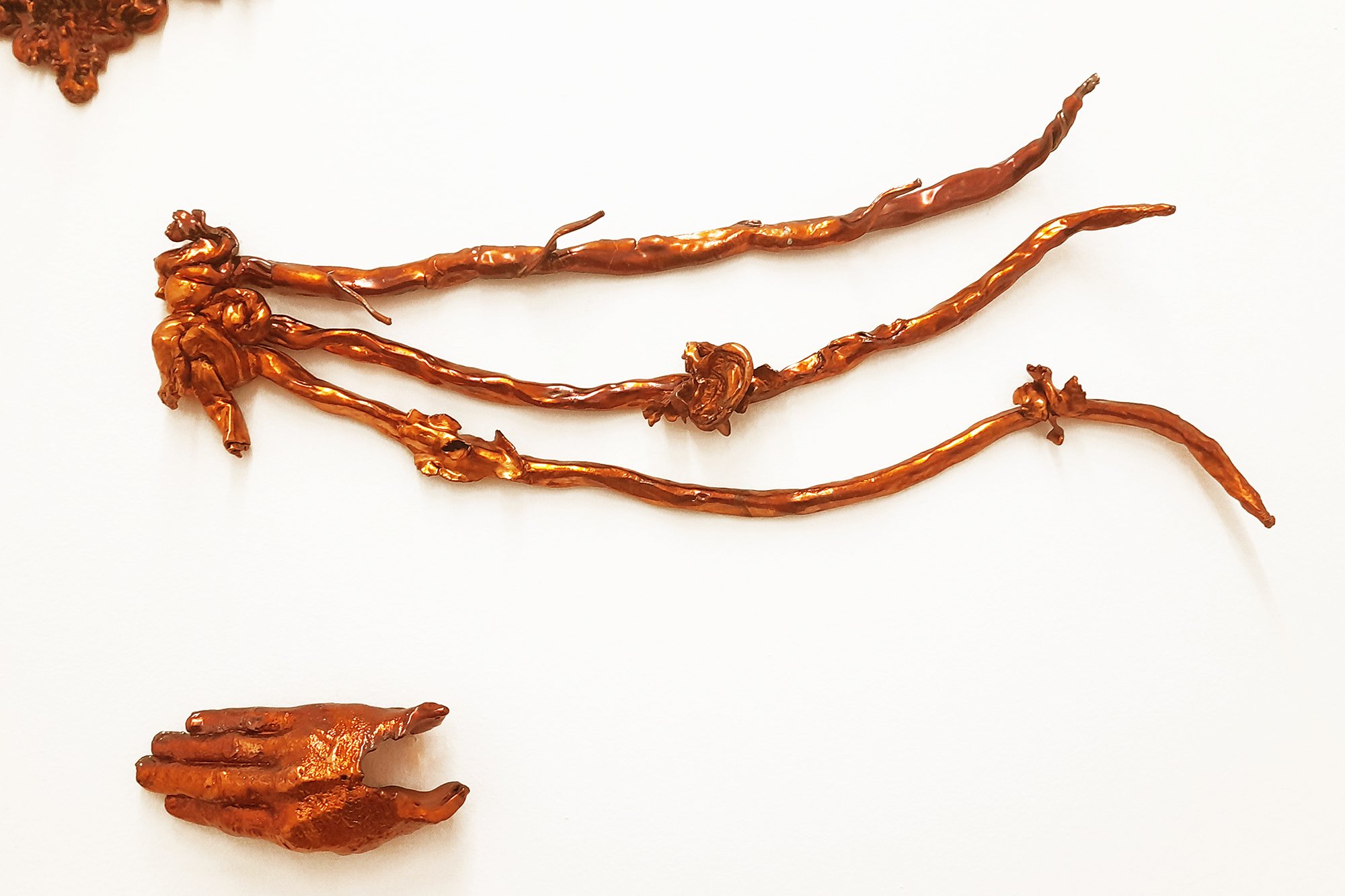
This cycle of works began with “The wings keep spreading and yet are never wings”, 2022 and and continued the following year with “Until its wings bear off the night’s middle witch”, 2023. The core of these works is the notion of nature that I started to research for “A cage in search of a bird”, 2022. Referencing the image of Medusa, a classical antiquity figure of a winged female that had snakes instead of hear, the works can be characterized as a semi-representational as they attempt a fusion of anthropomorphic and zoological attributes. The two works denote man’s relation to nature by creating a landscape of both intestines and exterior features that is reminiscent of an anatomy diagram used in biology studies. The final work emanates an atrocious quality of severed parts pieced together to create a hybrid being. Medusa’s ability to avert evil by turning those that looked into her eyes into stone, echoed in the alchemistic handling of the oxidized sulfur material of the sculptures.
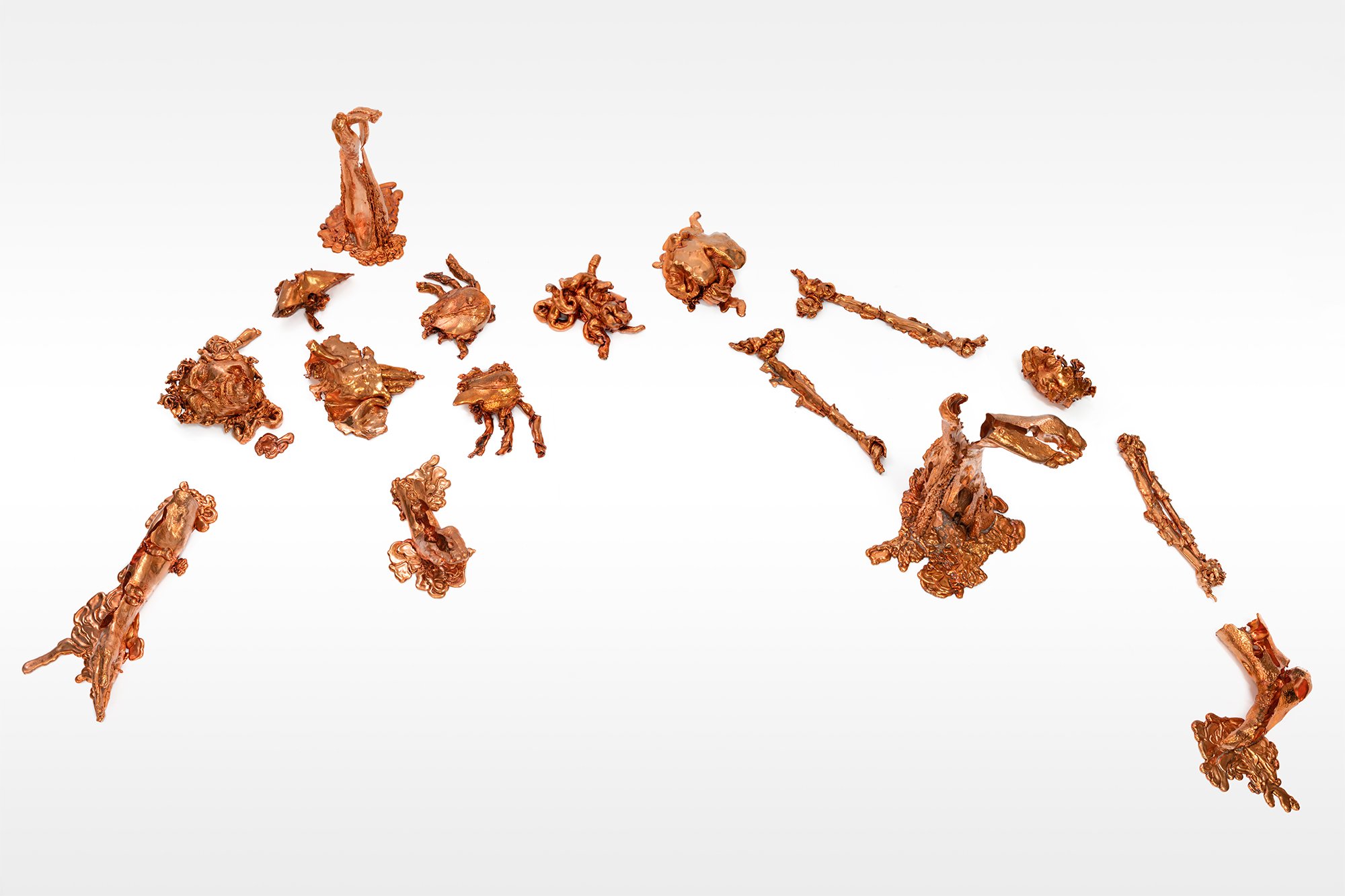
The work “More answers without questions” is the continuation of the work “Answers without questions”. Erichtho, a classical era necromancer, would scout civil war battlefields to collect limbs of fallen soldiers and re-assemble them in order to create hybrid bodies that would transmit her prophecy. By recreating life through lifeless parts, a potential predecessor of Mary Shelley’s Victorian-era Frankenstein, the witch manages to reverse time and capture it in a gruesome instant. Similarly, the soulless sculpture is produced via electroformed casts, a natural evolution to the wax molded work, resulting in hollow anthropomorphic figures reminiscent of ghosts. The work’s dismembered copper composition echoes images of archeological dig findings pointing towards the origins of Erichtho.
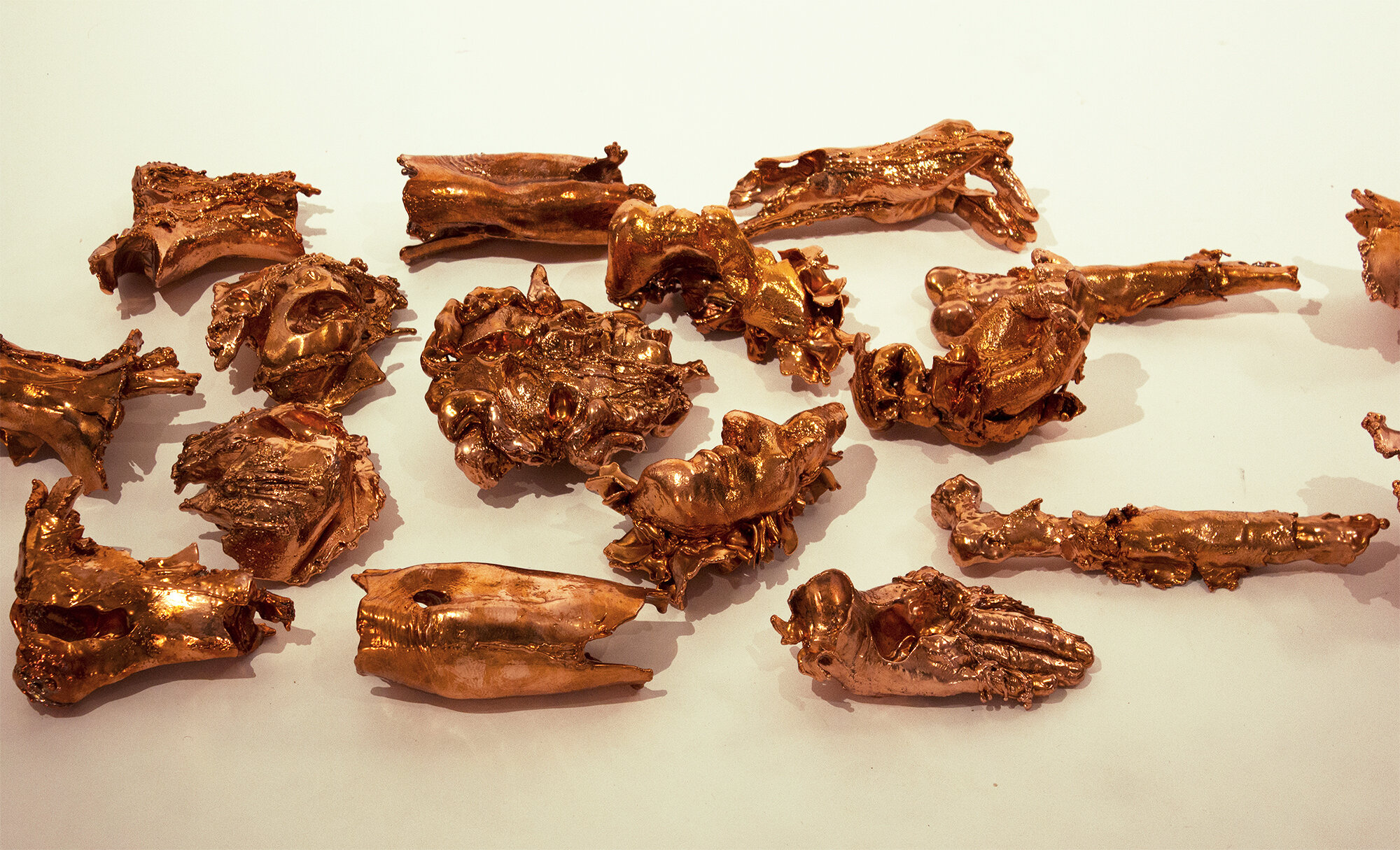
The work “Answers without questions” consists of 20 body part sculptures that form a complete body. In the Roman epic poem “Pharsalia” by Lucan the witch Erichtho is practicing necromancy using dismembered bodies she collected from the battle field in order to have an oracle to foresee the future. In a reverse procedure the twenty body parts are sculpted in wax using casts of my own body that have been burned and transformed. These sculptures are then electroformed with copper and the wax is melted away leaving the copper body parts to be assembled into a carcass. This newly constructed body can only provide questions and not answers about the future.
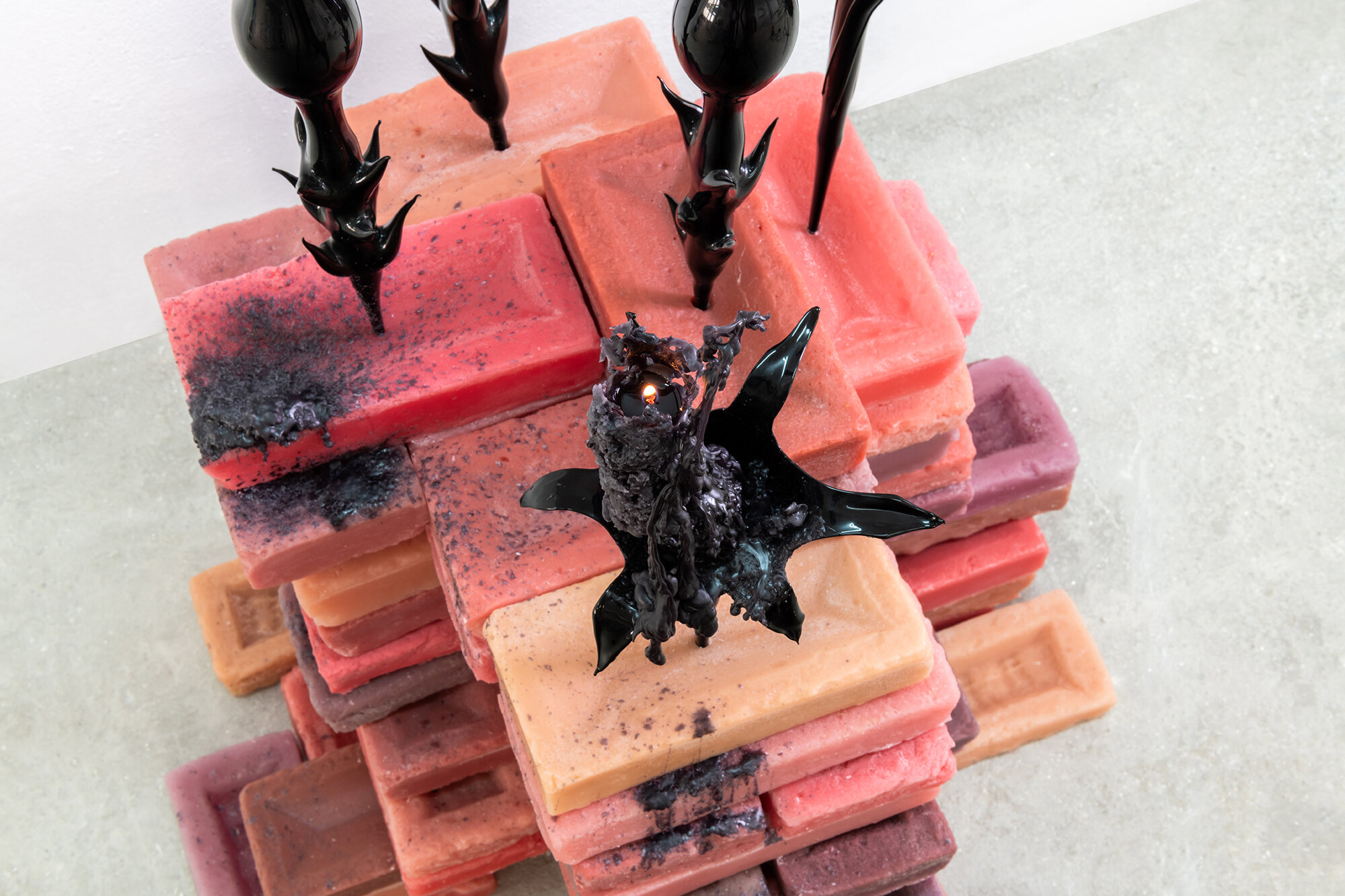
“Nihil” is a sculptural approach of the concept of the Eros and Thanatos drives and the manifestations of the instinctual processes within the sociohistorical production. The ambivalence and the common energy of these drives of the psychic mechanism are being constantly transformed in the context of the nature of society and where these drives intersect we reach to point zero. There everything melts in order to rebirth and flourish again.
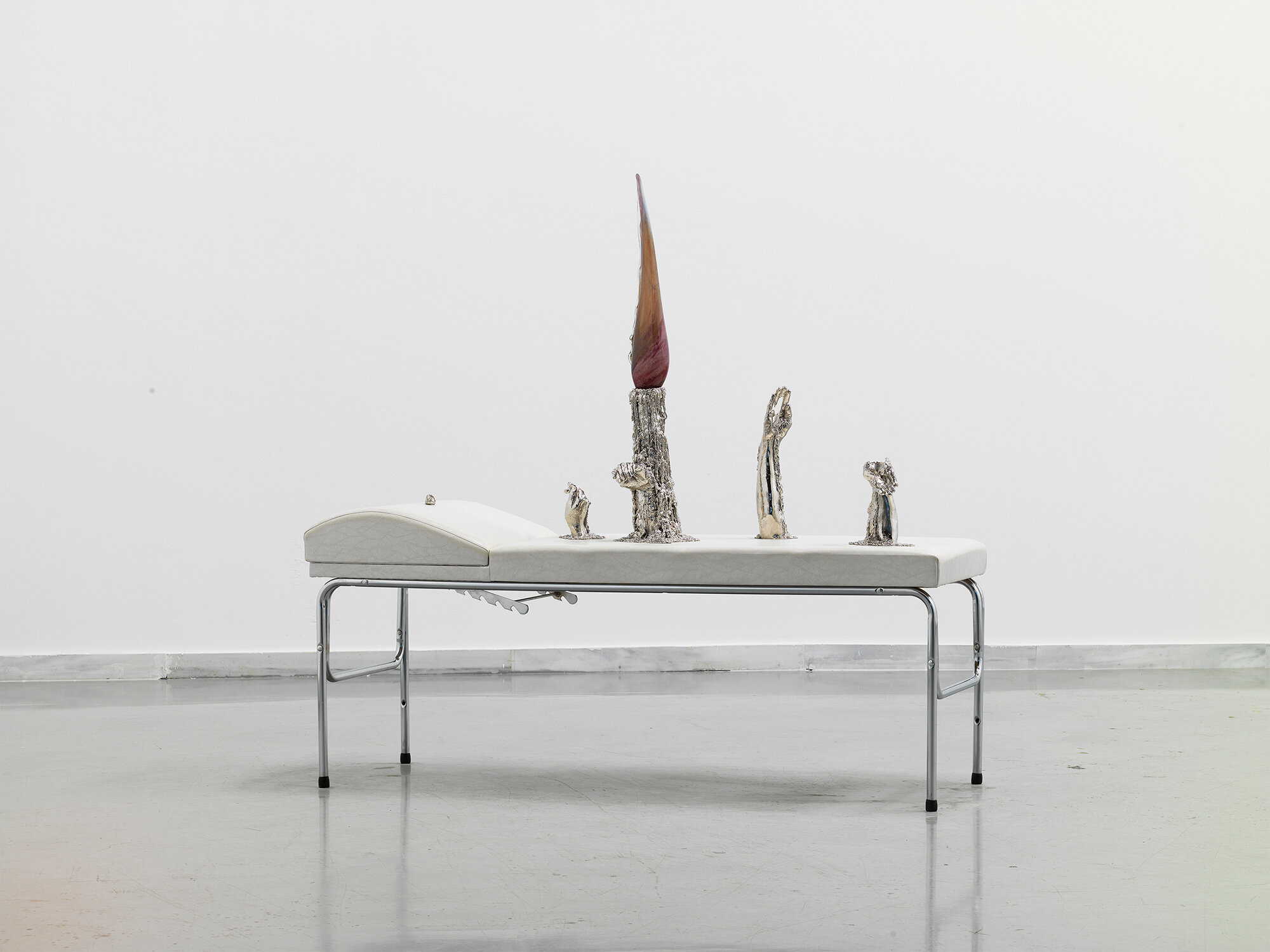
The installation “Wrong side of the bed” examines the state of the “undead”, the condition between the living and the dead and how this characterizes the entity and the role of a work of art itself. Each art piece has a presence and tries to interact with us but it really is a ‘non living’ body that strives to communicate with its environment. In this work the metal hollow transformed body parts acquire a different substance and along with the blown glass sculptures reanimate a new diverse ‘body’ that is being placed on medical furniture. This new body/shell is not affected by time neither is altered remaining in the state of the living dead. This undead subject carries the curse of the inversion of time which at this case is transformed like a glove pulled out of a hand leaving the inside out.
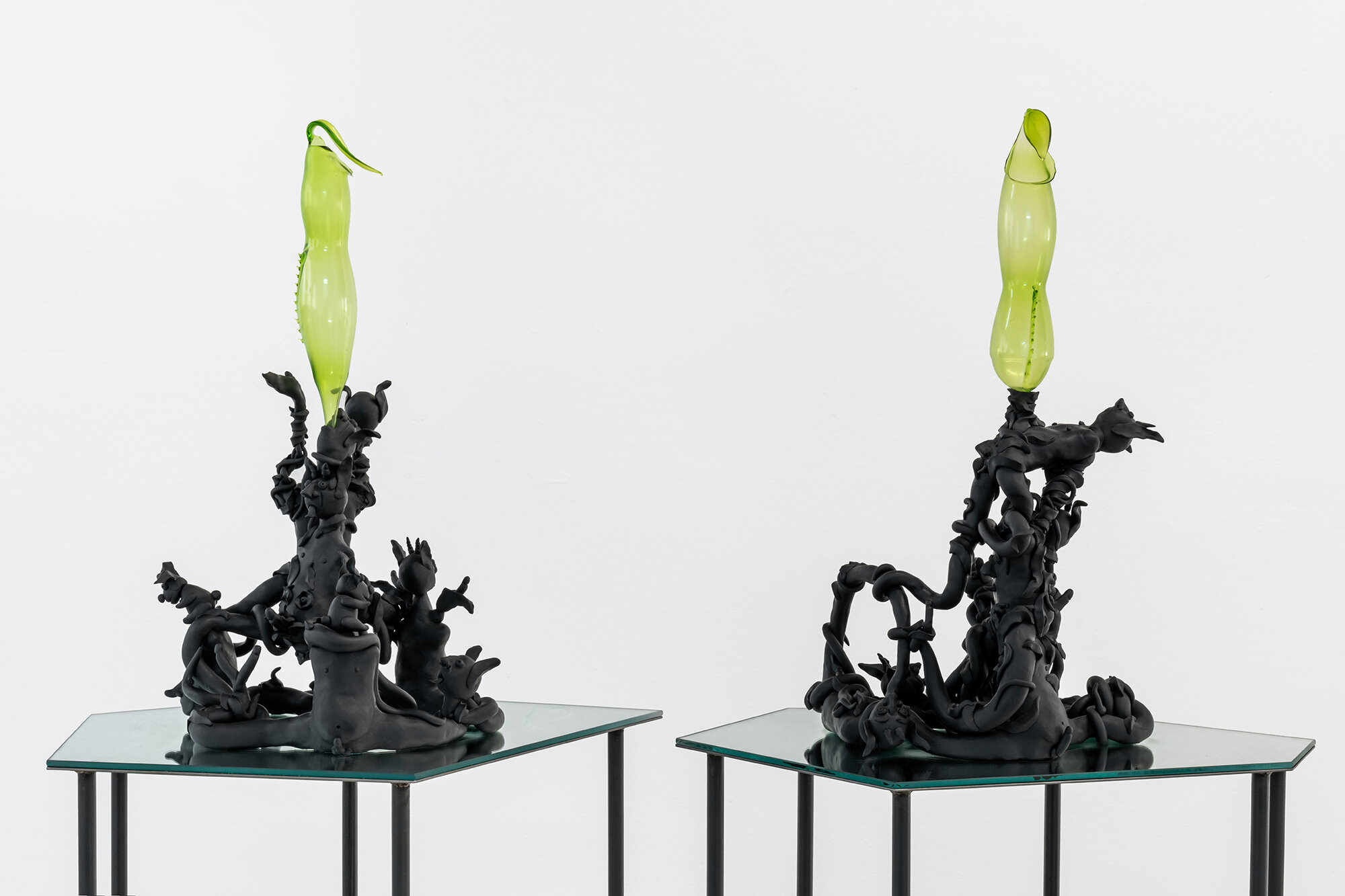
The two twin sculptures are constructed around the anatomy of the lesser female deity Baubo. In mythology Baubo entertained Demeter by exhibiting her genitals to her. The black male figures of the sculptural complex with their misplaced genitals are balancing a phallic Nypenthes flower made of glass. Those small figures try their best to entertain the viewer and to produce awe but contrary to Baubo they cannot provide relief to sorrow.
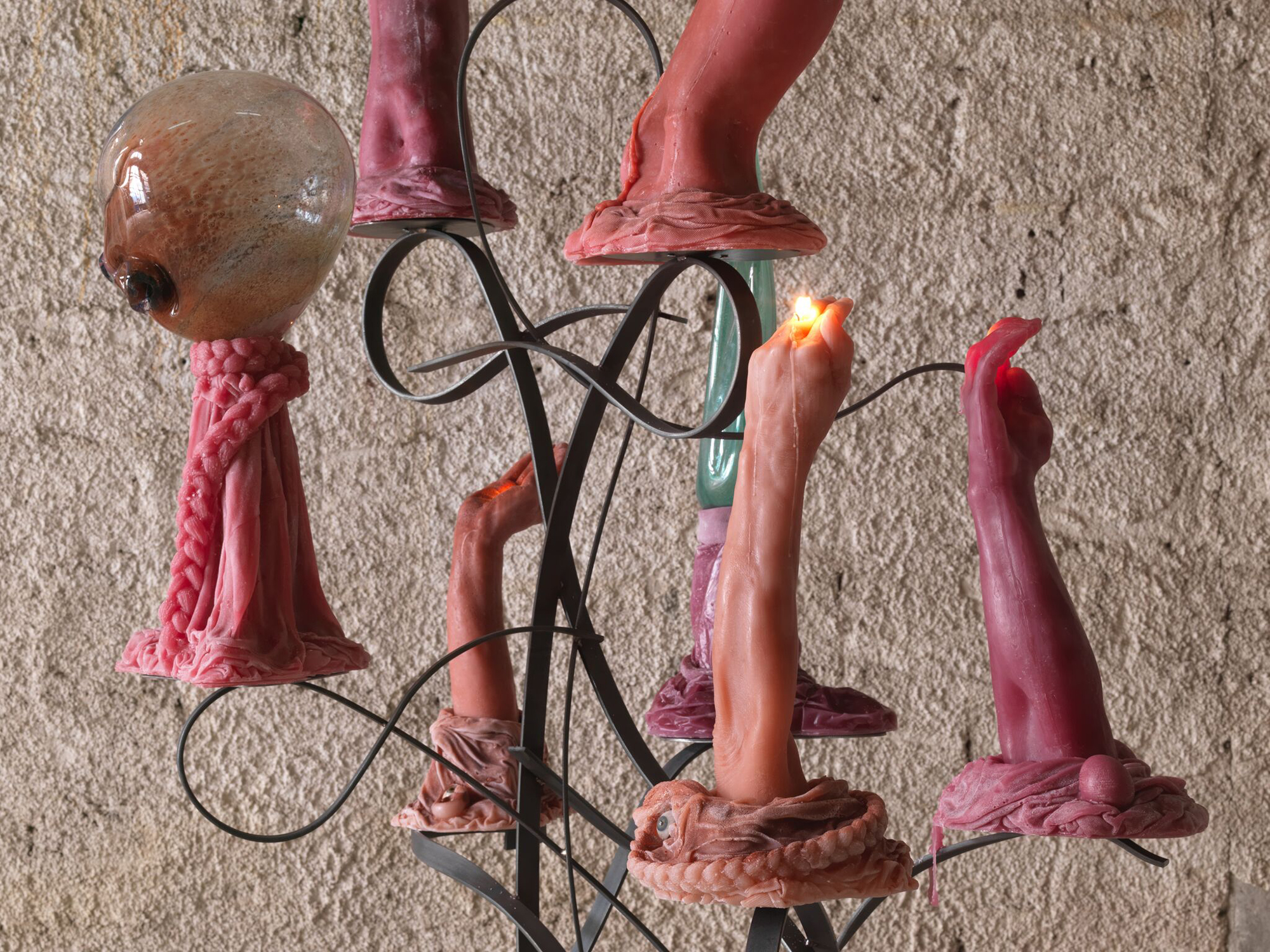
The work “Where the stream divides” has as a starting point the years of isolation of the painter Eleni Altamoura, after the death of her children, in her mansion on the island of Spetses until the exact dawn of the 20th century. At this time period she gets involved in spiritualism in an attempt to reconnect with her children leaving behind several legends but also a grimoire, a “magical” manuscript with spells. The three sculptures that compose the work are structured through the study of this manuscript and a visit to the house in Spetses and are consisted of fragments that oscillate between their vulnerability and the constant flow which reshapes them. While the wax elements of the work that stand on her occult writing are burned and transformed, the blown glass parts include a firm breath as a continuous incantation to the non visible. The invisible is the only getaway left for Eleni Altamoura when the physical world around her collapses and the first really independent Greek female painter of romanticism remains portrayed on the collective memory as a ghost that haunts the house close to the sea.
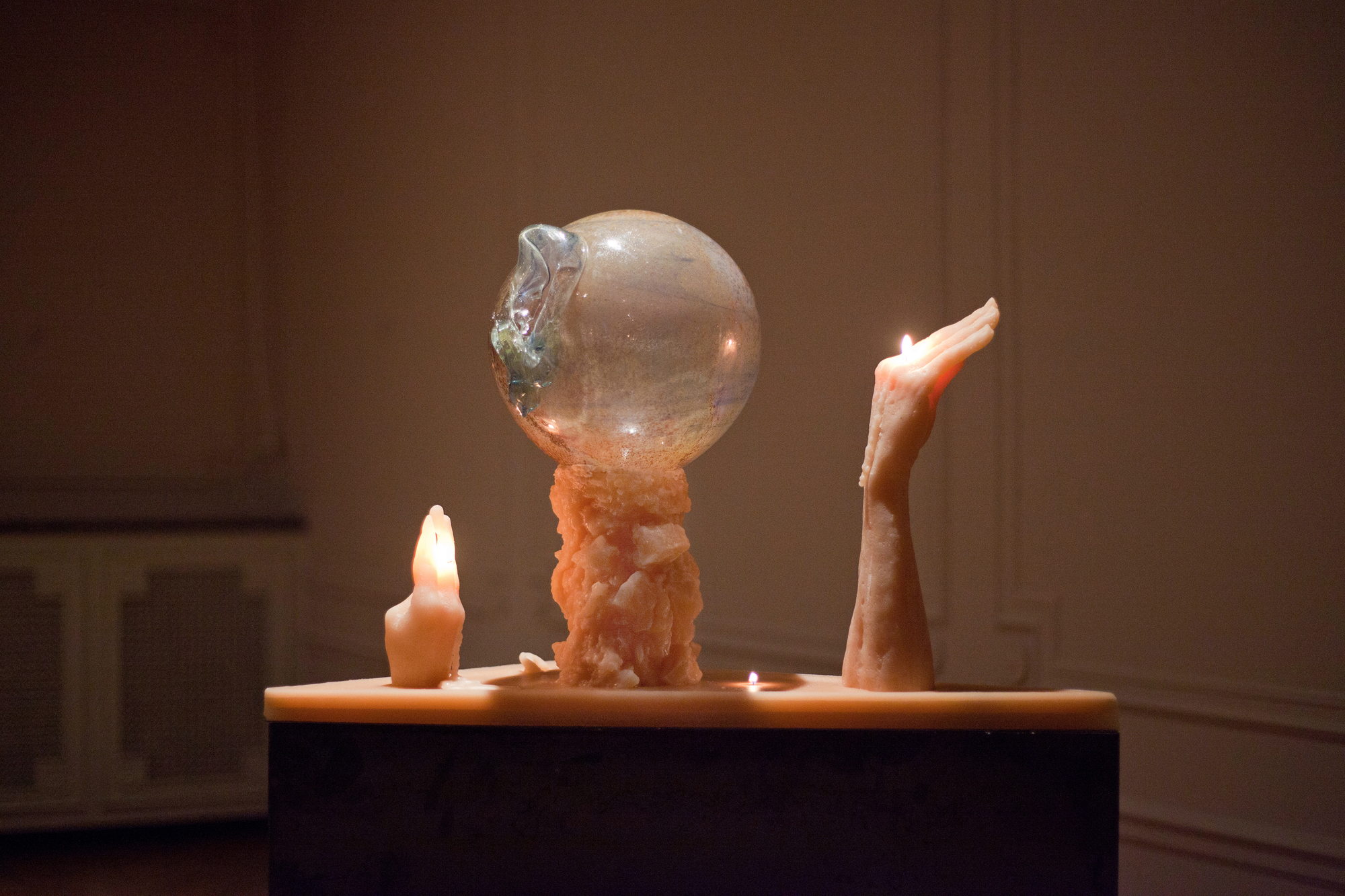
Could we visualize the ritual and the phenomena of hypnotism as ectoplasmatic landscapes of the brain? Having as a starting point the practices of spirit sightings and apparitions such as ectoplasms and wax spirit moulds the exhibition “It was evening all afternoon” is a gathering of traces and manifestations of the unconscious. In the show are exhibited 15 landscapes each one connected to a different frequency of brain waves during hypnosis that constantly change through their burning.

What constitutes the liquidness that flows within solid daily routines? Which conditions and conjunctures spark off the alteration of consistency? States of instability and transformation feed the rhythm that is being inscribed as everyday life.
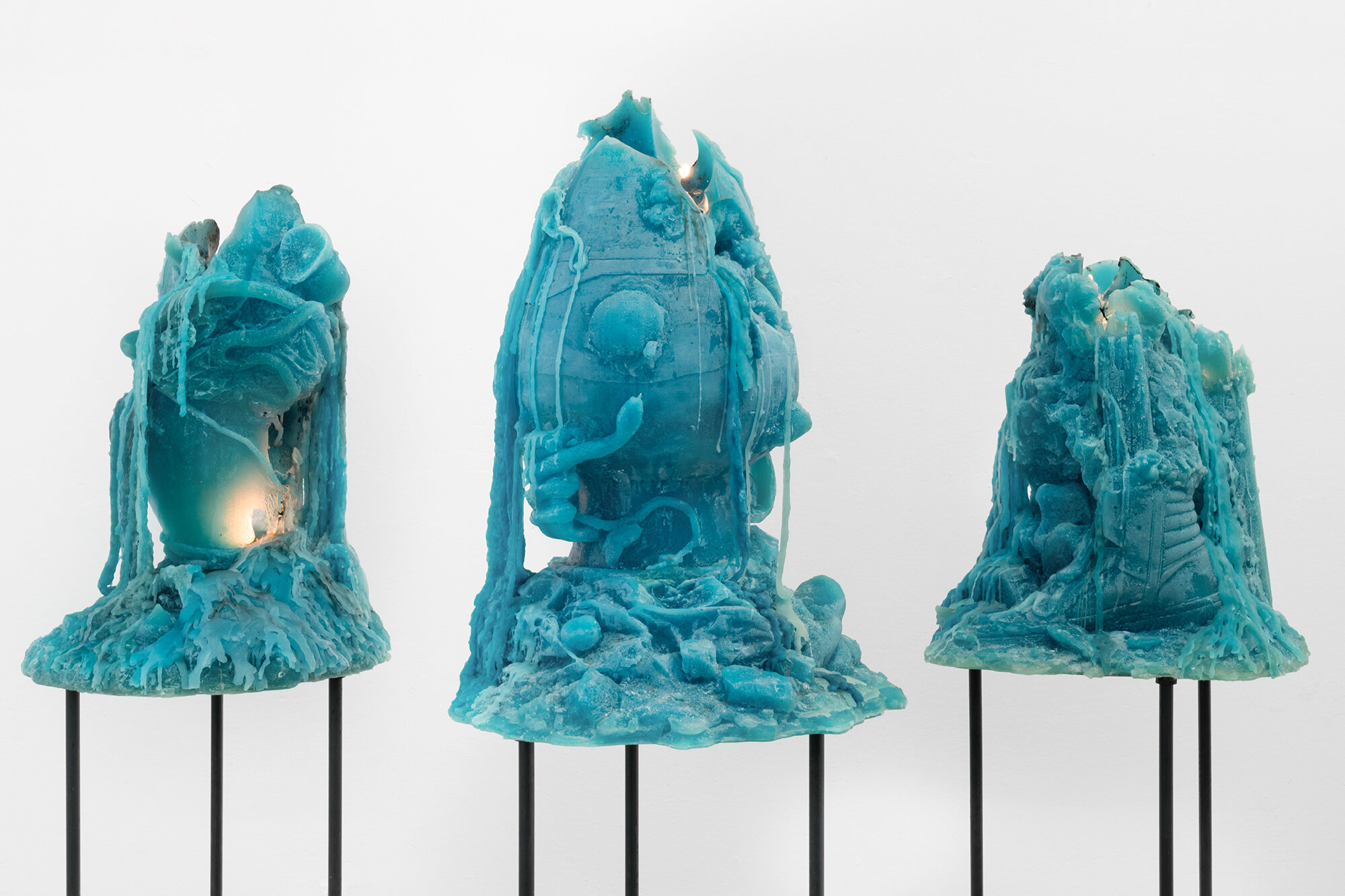
The installation “The serpent’s tears” consists of three piles of debris and relics of various objects and timeframes made of wax that can be burned during the exhibition balancing between the valuable and the useless. While they burn their different chronical origins they carry are dissolved and all the objects assimilate and dematerialize like memory. The installation was commissioned by NEON Organization.
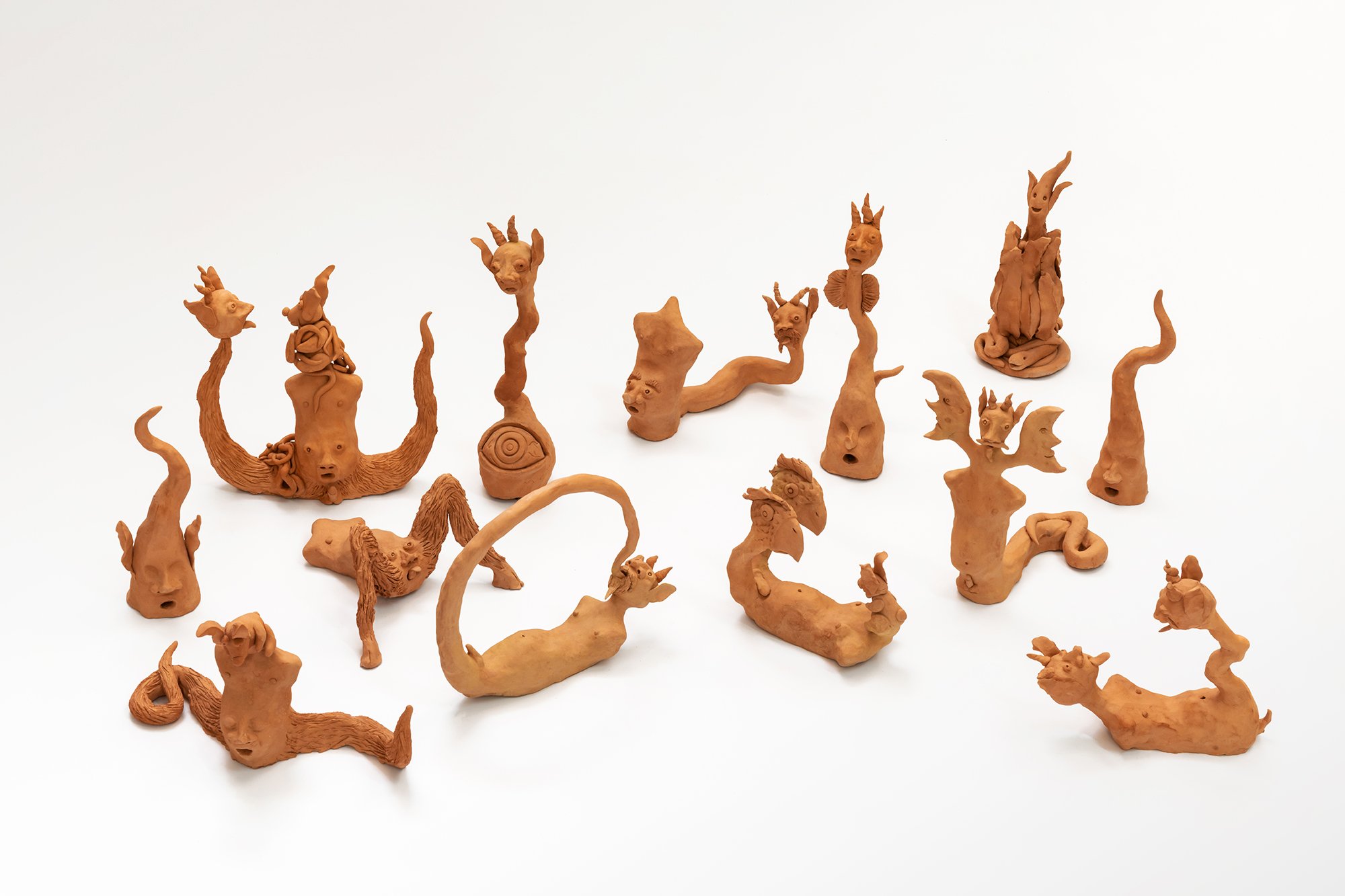
“The Fools” are 13 sculptures about the concept of haunting on the Greek islands and especially in Nisyros where the revenant used to be called “varvalakhos”. The “Fool” in the tarot games is also the most valuable card. They were presented as an apparitional installation at the Old Baths in Nisyros as part of “Making Oddkin- For joy, for trouble, for volcano love” program curated by Nadja Argyropoulou.
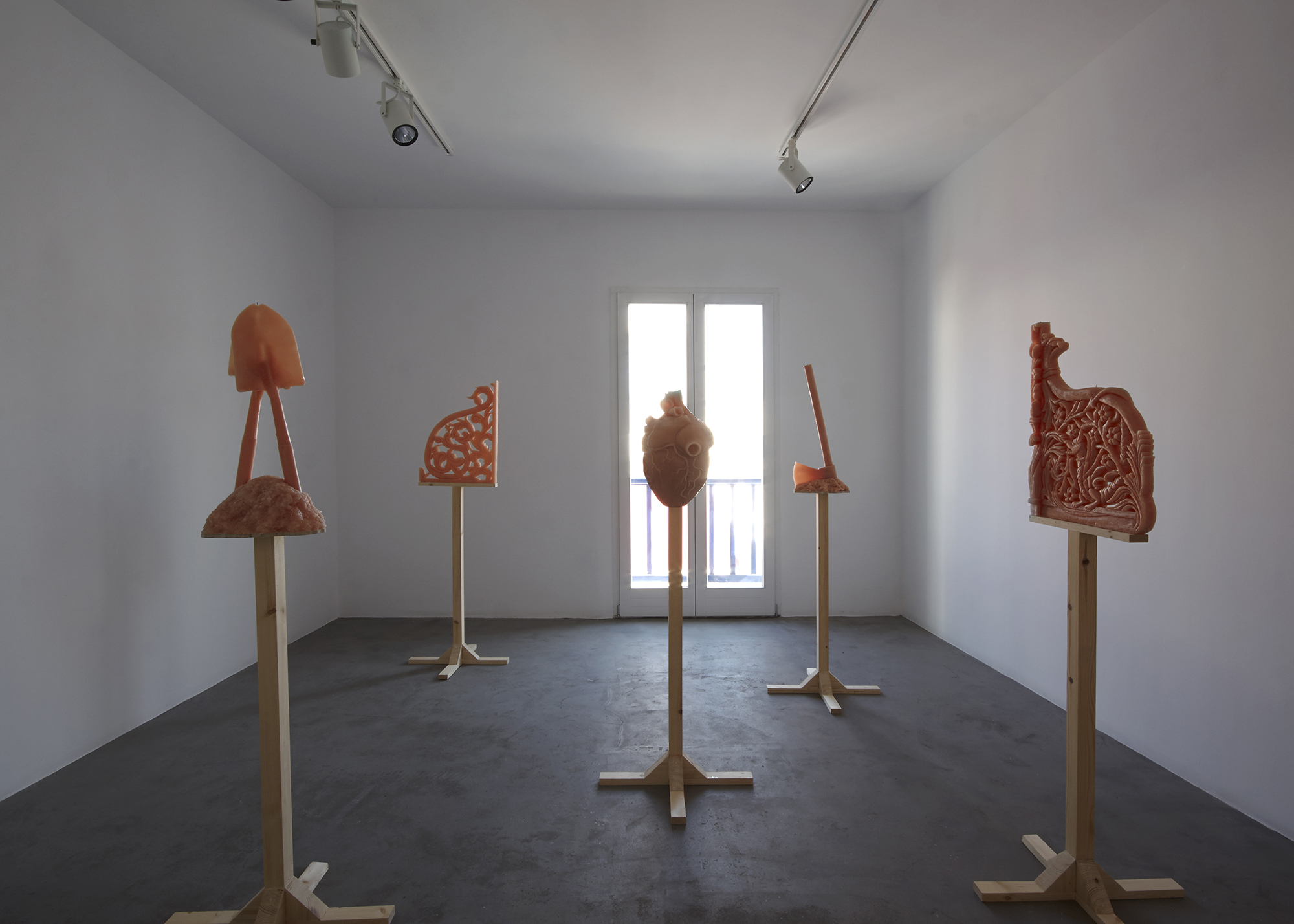
In the winter of 1701 the French botanist and traveler Joseph Pitton de Tournefort while he had stationed on the island of Mykonos witnessed the exhumation and extraction of the heart of a suspected vampire (vrykolakas) according to the local community. The body was eventually burned in order to be purified and Tournefort recorded this incident that was later published in his work “Relation d’ un voyage du Levant”. By revisiting the island and through the descriptions of the Myconian rituals in the book these wax sculptures form a link with the primordial superstitions of the island’s residents and as all legends function as a fuel of the memory.
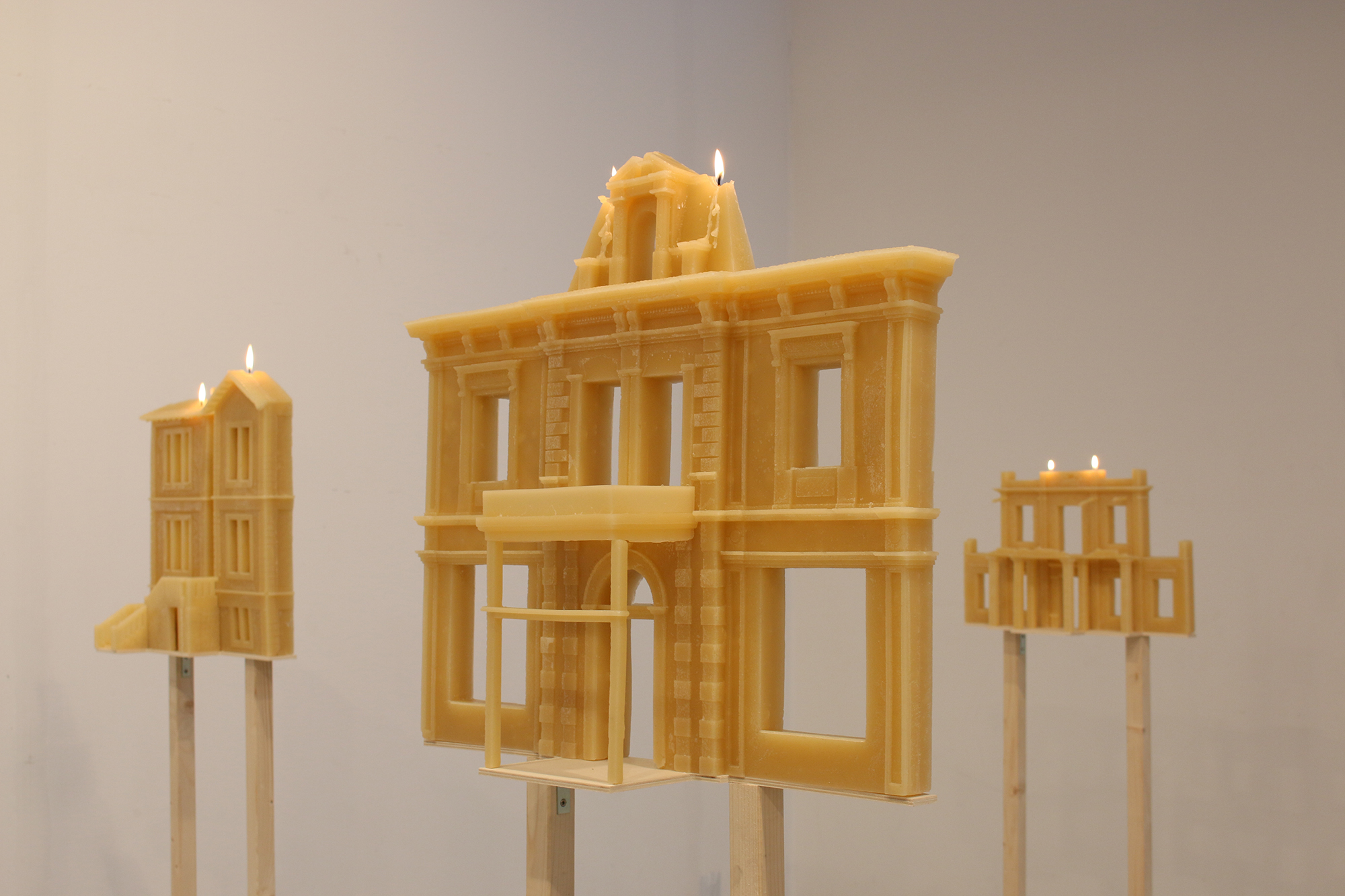
In “Ghost Relief I–V” having as a starting point the stories of the haunted houses in Greece my interest focuses on the survival and cultural transformation of these buildings in uncanny monuments of the oral history that surrounds them. The buildings are the vessels of the city’s history and the ghosts the personification of its history. The haunted houses, the topos of the uncanny par excellance, offer a particular reading of a place’s history. Working on the crossing points of historical facts and fictional stories through the reapproach of the folklore and superstitions and their transformations in the contemporary sociopolitical context I try to portray their facade as a part of the urban memory which maintain a special place in the imaginary of the inhabitants. The wax models of their facades stand as ephemeral portraits of their presence, as phantasmas, as a fuel of memory.
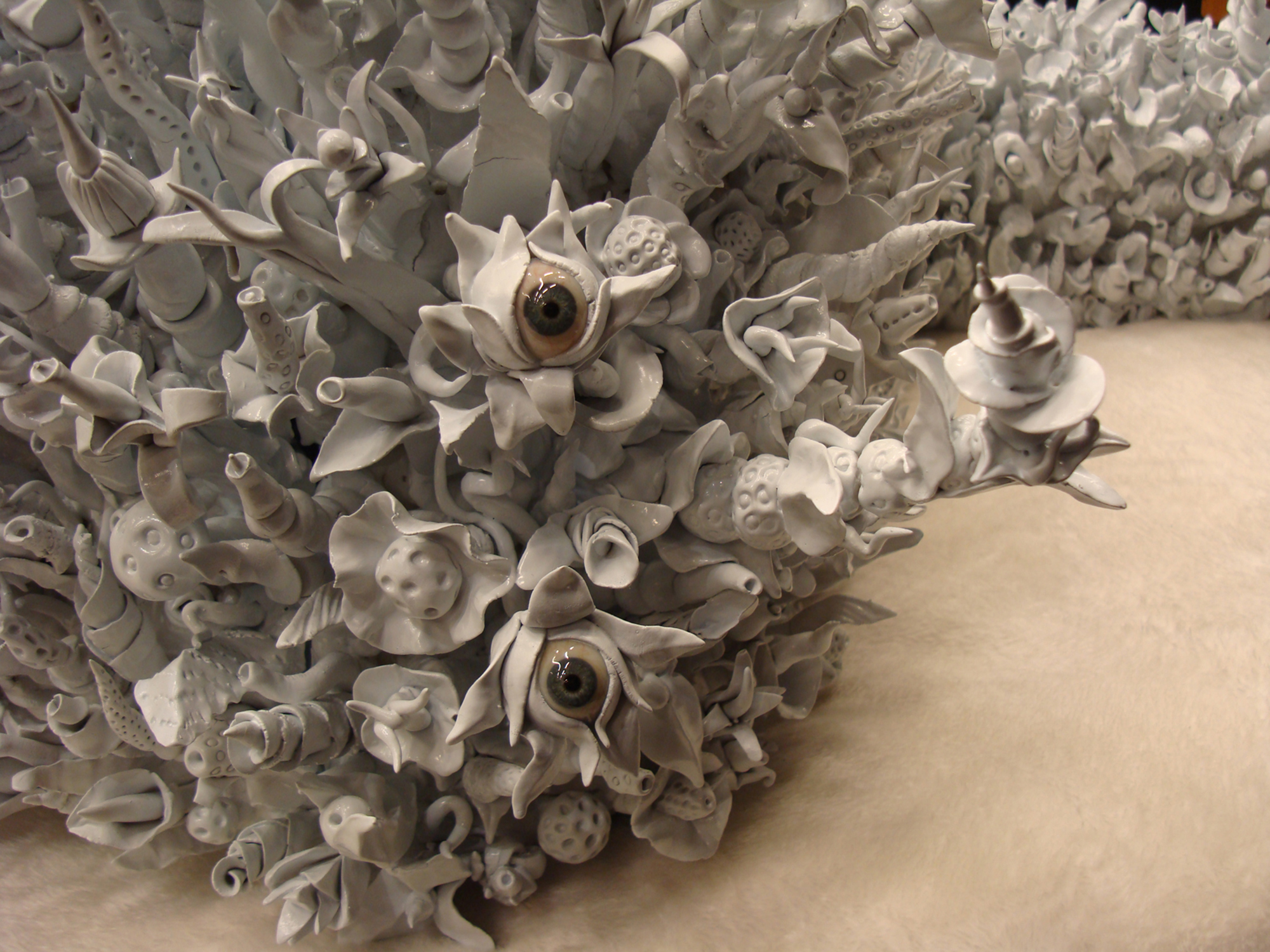
The work “The Gates of Horn and Ivory” is a collaborative work with Panayiotis Loukas and was commissioned for the group show “Hypnos Project” organised by Onassis Stegi. The installation investigates sleep as an ecosystem that is consisted of all what it surrounds it and haunts it. The sculpture refers to everything that decorates and complicates our sleep, to its flora and fauna and to a construction of a conceptual transition from the hypnagogic to the hypnopompic state. This project is about all that lives and exists while we sleep.
The title of the work derives from “Odyssey” where Penelope says that dreams are sent through two gates. The dreams that are signs come through the gate made of horn and the dreams that are false come through the gate made of ivory.
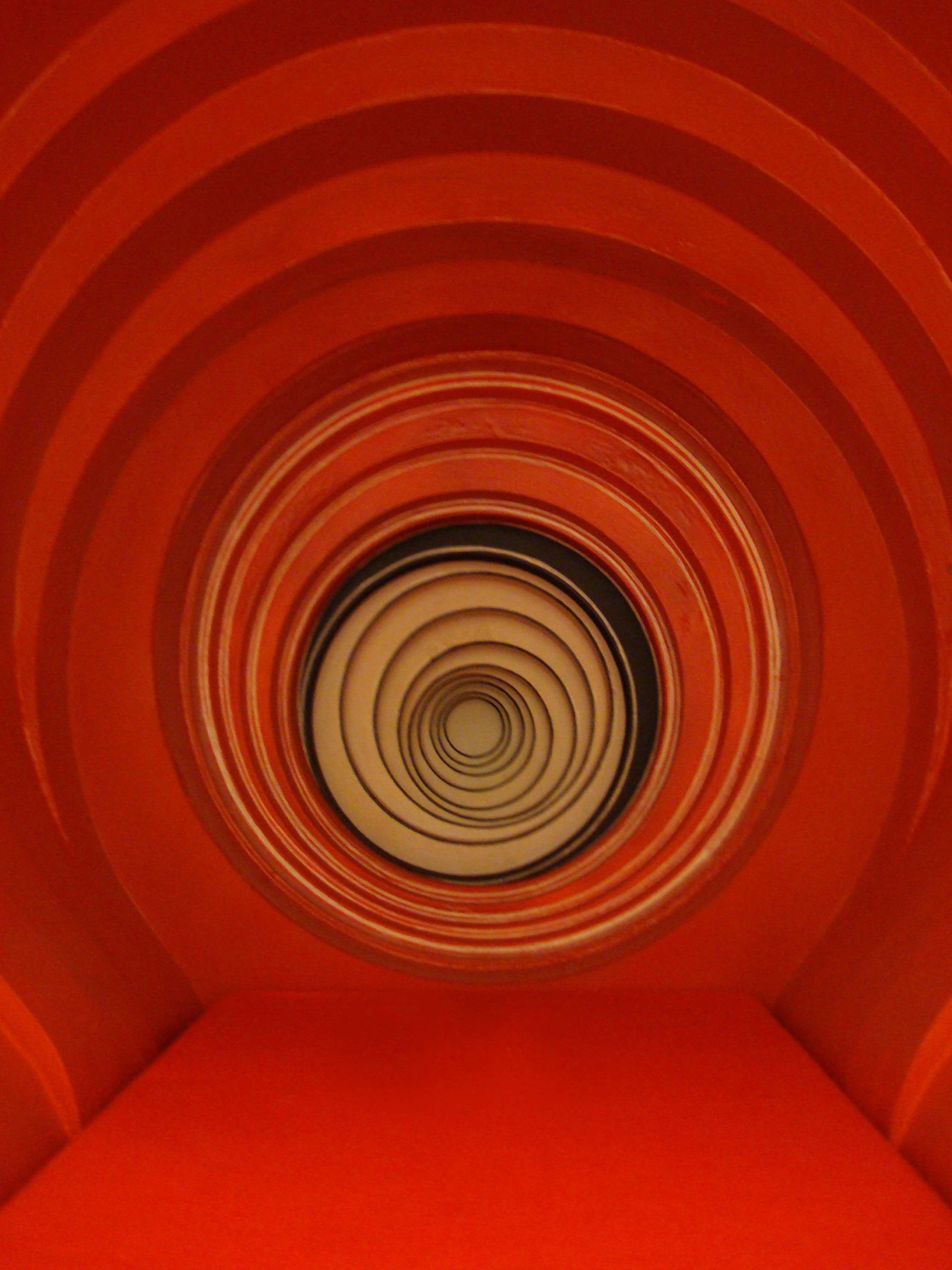
“L’Endormeuse” is an attempt to investigate the relations between real/imaginary, subject/object, active/passive, private/public and suggests a hybrid environment, a room-machine of an hypnotic experience which comprises out of three elements: the “Rotorelief” (the sleeping machine), the “tub” (the sleeping space) and the bed. The design of this installation-room began with the transformation of Marcel Duchamp’s’ hypnotic disk “Chinese Lantern”, one of the “Rotoreliefs”, in three dimensions creating the spatial dimension of the geometric motif of the disk.
The geometry of the “Rotoreliefs” is based on eccentric circles slightly misplaced, which produce a warp and the illusion of a three dimensional space when they turn with the help of a motor at a steady rhythm. The beating rotating movement of the “Rotoreliefs” is related with the throwing of the pottery maker and from the “Anemic Cinema” by Duchamp we are transferred conceptually at the tub of Diogenes in which he slept. The logic of the eccentric circles is also transfused at the design of the sleeping space, the “tub”, which is the steady part of the construction. This is about an installation, a kind of experimental sleeping-room that exists as an isolation space in which the user is behaving passively and is subjected by the room itself in the sleeping routine. “L’Endormeuse” being a machine acts as a “conductor” between consciousness and the state of sleep and under certain conditions can lead to the hypnopompic and hypnagogic experiences.